
ABM and ABX
We Turn Target Accounts Into Pipeline and Renewals
Account-based marketing services for B2B software companies, built to keep running after the deal. One account view across marketing, sales, and customer success, from first touch through renewal. Also called ABX.
Trusted by B2B software teams running ABM against accounts that matter






Who This Is For
Three Ways Account-Based Programs Quietly Break
The campaign usually looks fine. The problem sits upstream in the list, sideways in who gets reached, or downstream when the deal closes.

Account list lives in a spreadsheet
Your list is a sheet, and nothing writes back
A BDR works the list by hand, outcomes stay in their notes, and the system never learns which signals converted.

One contact, one channel
You are running account marketing at a single person
Forrester puts the typical B2B decision at around 22 stakeholders. Most programs reach one of them.

Everything stops at signature
The account disappears the moment the deal closes
Customer success inherits an account with no context, expansion gets worked from memory, renewal arrives as a surprise.
How We Work
Four jobs. The list comes first.

Building Account List
Tiered accounts from fit and live signals, refreshed on a cadence.

Buying committee mapping
Every role that touches the decision, not the first one to reply.

Running paid and outbound together
Same accounts, same week. Ads warm the committee; outbound opens it.

Reporting
Reached, engaged, won, onboarded, expanded, renewed.
How It Connects
Most programs stop halfway.
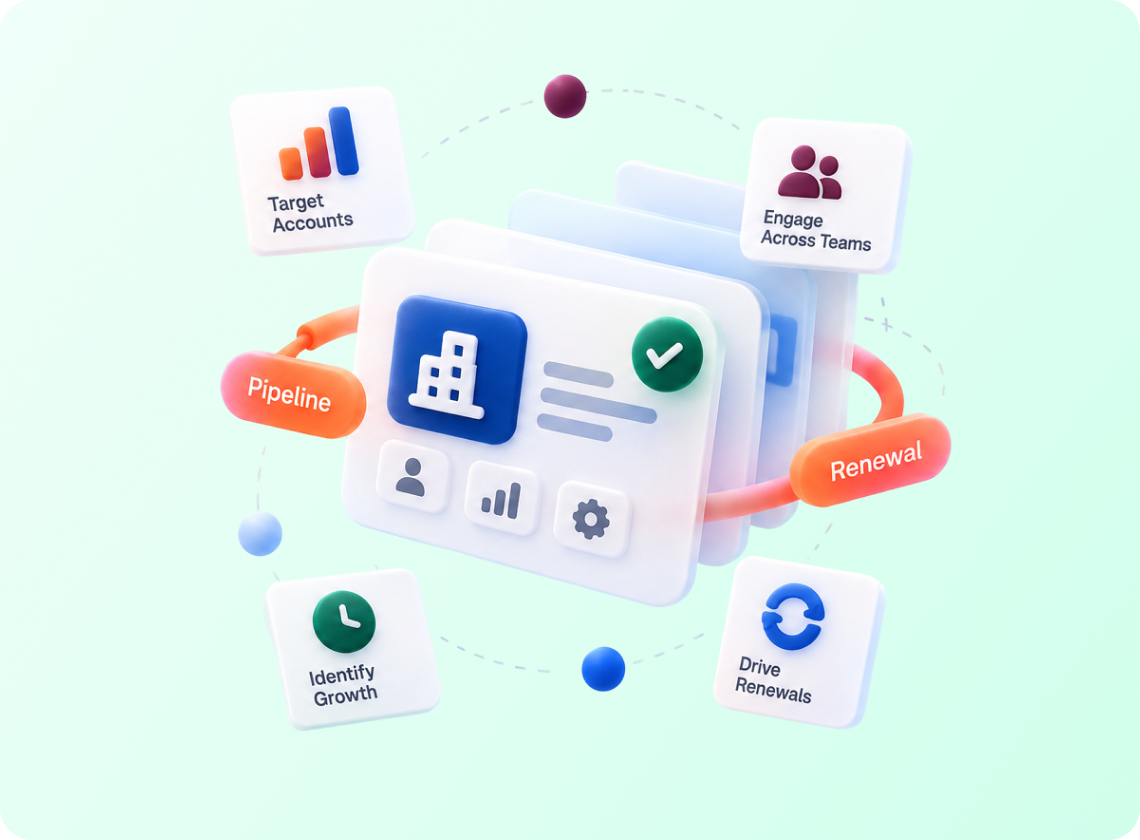
Every target account moves through eight stages. ABM covers the first five.
ABX keeps the same list, signals and reporting running through all eight.

Same list. Same signals. Same report. The account record does not reset at signature.
WHAT WE BUILD
Account-Based Services We Deliver

Account list and tiering
Accounts scored on fit and live signals, sorted into tiers, refreshed on a cadence.

Multi-threaded account campaigns
Paid and outbound at the same accounts, reaching every role on the committee.

Lifecycle reporting and expansion signals
One account view across marketing, sales, and customer success.
Explore by Role
Four People Decide. They Need Different Things.
Forrester puts a typical B2B decision at around 22 stakeholders.
These four shape the outcome, and one message won’t work for all of them.

Economic Buyer
Wants the business case and the downside risk. Rarely reads your feature page.

Champion
Already sold internally. Needs ammunition to carry the room without you present.

Technical Evaluator
Reads the docs, tests the claims, and decides quietly whether you are credible.

Procurement
Arrives late, compares on price, and can stall a decision everyone already made.
HOW AN ENGAGEMENT WORKS
Built in public. Yours to keep.
Account review
Your list, committee coverage, and what happens after close.
List and tiers
Sales signs off before media spends anything.
Campaigns live
Two-week cycles, adjusted against account movement.
Hand Over
Tiering logic documented, every audience in your own accounts.
Here’s what our amazing clients are saying


The Nextvant team helped us build a robust MAP system for our multiple systems & requirements. As they progress ahead and build more competencies across the B2B marketing ecosystem
Blog
The Nextvant Journal
Ideas, observations, and practical lessons from the front lines of B2B growth.
- How this company reduced 30% of bad leads by transforming from Pay As You Go to Bundle PricingRead More: How this company reduced 30% of bad leads by transforming from Pay As You Go to Bundle Pricing

- Pricing Strategy For New Products — A Complete guide for foundersRead More: Pricing Strategy For New Products — A Complete guide for founders

- How to make your first outbound call — A step by Step GuideRead More: How to make your first outbound call — A step by Step Guide

FAQ
Frequently asked questions
What is ABX?
Account-based experience is a go-to-market strategy that applies account-based targeting and orchestration across the full customer lifecycle, from first touch through onboarding, expansion and renewal. Demandbase defined the term in 2021. The practical difference from ABM is that marketing, sales and customer success work from one account view rather than handing off at signature.
What is the difference between ABX and ABM?
ABM is a targeting strategy focused on winning named accounts. ABX is a lifecycle strategy that keeps the same list, signals and reporting running after the deal closes. ABM asks which accounts to target. ABX asks what happens to those accounts at every stage, including the stages after they become customers.
Is ABX just a rebrand of ABM?
Partly, and the criticism is fair when a team changes the acronym and keeps the same programs. The operational test is simple: does your account reporting stop at the opportunity, and does customer success see the same account view marketing does? If the answer is no to the second, you are running ABM with a new label.
How is this different from GTM engineering?
ABX is the campaign and the lifecycle motion: creative, channels, sequencing, and the reporting that follows an account past close. GTM engineering is the infrastructure that decides which accounts and when. Most account programs underperform because the list was built once in a spreadsheet, not because the campaign was bad. If your list is stale, start with engineering.
How many accounts should be on the list?
It depends on the play. One-to-one works at ten to fifty accounts with custom creative. One-to-few runs at a few hundred in clusters sharing a trigger. Programs trying to run one-to-one economics across a thousand accounts are the most common way this budget gets wasted.
Do you run the ads yourselves?
Yes. Paid media is in-house rather than subcontracted, so paid and outbound can hit the same accounts in the same week. Most agencies in this category hand media to a partner, and the two channels drift out of sync within a month.
How do you measure ABX?
By account, across eight stages: target, reached, engaged, meeting, won, onboarded, expanded, renewed. Reported by tier, so the next decision is about targeting or timing rather than ad copy. Cost per lead is not an account-based metric.
Our marketing and sales run on different CRMs. Can you still do this?
Yes, and it is common. Account-level reporting needs the two sides reconciled first, though, or the report will disagree with the forecast. That is RevOps work and we scope it separately rather than burying it inside a campaign retainer.
We have 300 contacts from a conference. Can you run a program against them?
Not as-is. A badge scan list is contacts, not accounts, and it mixes real buyers with people who wanted the tote bag. We score it against your ICP, keep the accounts that qualify, and fold them into the existing list rather than treating the event as its own campaign.
How long before accounts move?
Reach and engagement move inside the first cycle. Meetings depend on the committee and the deal size, usually a quarter or more for enterprise lists. Post-close signals take a full renewal cycle to mean anything. Anyone promising meetings in month one is describing outbound.
Which CRM do you work in?
Yours. Nextvant is a HubSpot Gold Partner, and most builds run there. We also work alongside Salesforce, including setups where marketing runs on one platform and sales on the other.
What do you need from us to start?
Your current account list, access to your CRM and ad accounts, and a sales counterpart who can sign off on targeting. For the post-close stages, add whoever owns customer success. Sales and CS agreeing on the list is the single biggest predictor of whether this works.
Let’s Talk
Bring your account list and your last quarter of reporting. The review shows which accounts are stuck, which committees you are missing, and what happens after close. You keep the findings.