
Table of Contents
As the calendar flips to new pages. And we enter the first month of a new year.
SaaS companies across the globe come up with their share of reports.
But the report that is much awaited by SEO experts, content writers, Performance marketers, and product marketers alike is – the SEMRush Google Ranking Factors Report.
The latest report is 99 pages long! 😮💨 (If you still wish to read it, you can find it – here)
But
I decided to read it, and here is everything I found interesting.
But before we start
What are Google Ranking factors, and why should I care?
Let’s start with how Google explains it –
“To give you the most useful information, Search algorithms look at many factors and signals, including the words of your query, relevance, usability of pages, expertise of sources, and your location and settings. The weight applied to each factor varies depending on the nature of your query.” (ref)
To put it in simple terms
Ranking factors are elements or signals of your website that Google considers while looking for information.
These could be the content’s relevance, length, URL structure, images, or simply the website on which the content has been written.
How your content or page accesses these factors depends on how top the order would rank on the Google search engine.
Higher ranking often results in higher organic traffic to the website, increasing business.
There are hundreds of factors that impact your ranking on Google.
And that’s the reason SEO experts across the globe spend hours and hours going through the updates and implementing them on the website.
So, what does SEMRush Reports cover?
SEMRush 2024 reports give a critical insight into Google’s ranking factors that reflect the evolving SEO landscape.
It emphasizes a heightened emphasis on content quality and relevance and a gradual shift away from the keyword density metrics.
The report also highlights the growing significance of the user experience on the website, which is often governed by site speed, mobile friendliness, intuitive design, etc.
There is also mention of a renewed focus on backlink strategy, with the quality and context of backlinks being more important than the sheer quantity.
These insights give a holistic approach to SEO strategy, which would help achieve a higher ranking on Google.
NOTE: I have divided the summary into 3 categories:
Key Metrics - Top metrics that impact your SERP positionTop Tips - Tips to improveTo Avoid - Things to refrain from to improve your rankings.
Let’s dive deep into each section of the report.
1. Content Quality & Relevance
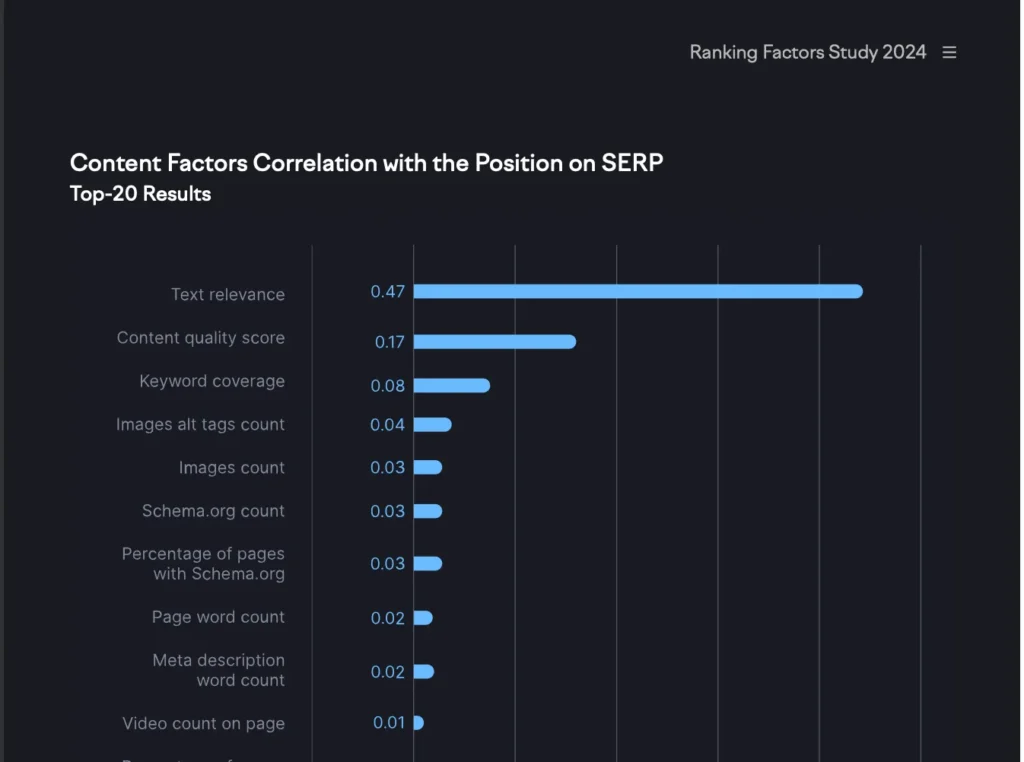
The section emphasizes the relevancy of the content with the search query, which is evident based on the result in the image below. It’s time authors keep their focus on E-E-A-T for a longer term. The number of words, keywords, Readability score, etc., had a very low significance in ranking a particular page.
- Key Metrics:
- Depth and Comprehensiveness: Coverage of topics in a thorough and detailed manner.
- Content Freshness: Regular updates and addition of new, relevant information.
- User Engagement Metrics: Such as time on page and bounce rate, indicating content relevance and quality.
- Top Tips:
- Focus on User Intent: Tailor content to meet your audience’s needs and questions.
- Use Rich Media: Incorporate relevant images, videos, and infographics to enhance user engagement. (*Google loves images on the page)
- Regular Updates: Keep your content updated with the latest information and trends in your industry.
- Structured Content: Use headings, lists, and short paragraphs to make content easy to read.
- To Avoid:
- Avoid Thin Content: Don’t publish content that lacks depth or doesn’t fully address the topic.
- Steer Clear of Over-Optimization: Don’t overuse keywords at the expense of natural language and readability.
- Refrain from Neglect User Experience: Ensure that the content on your site is informative and easy to navigate and engage with.
2. The Impact of Backlinks
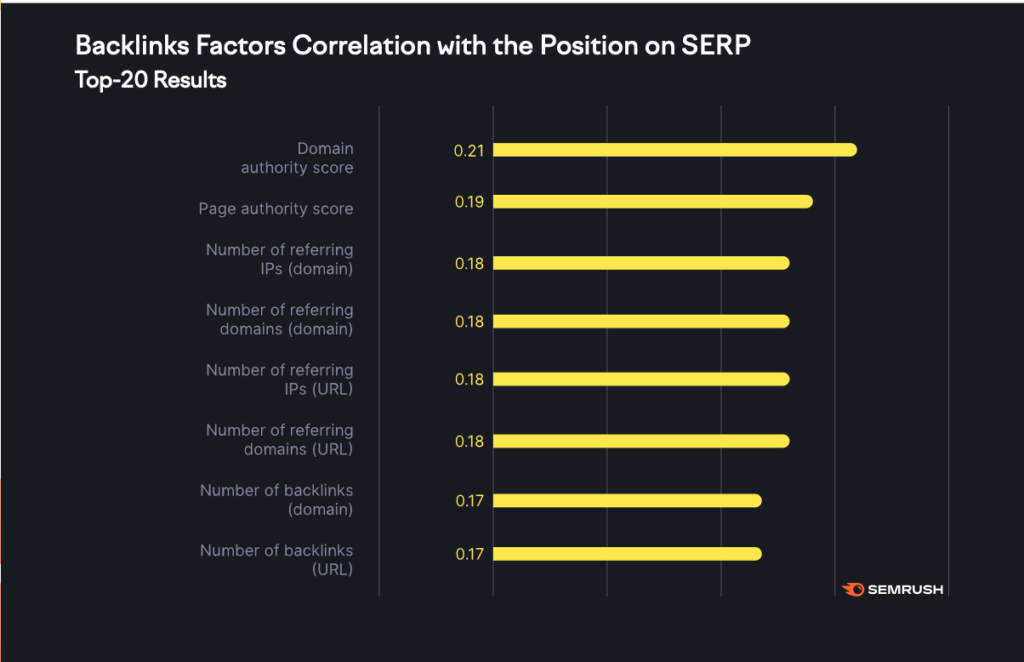
Google would focus a lot more on the quality of backlinks than the quantity. As an SEO expert focusing on backlink building, I target relevant backlinks that add value. Unethical hacks might be penalized severely going forward.
- Key Metrics:
- Backlink Quality: The authority and relevance of linking domains to your niche.
- Backlink Quantity: Backlink quantity would play a role but with less importance.
- Link Diversity: Focus on the variety in types of backlinks (e.g., from different domains, different types of content).
- Top Tips:
- Create Link-Worthy Content: Develop content that naturally attracts backlinks, such as original research, comprehensive guides, or insightful analyses.
- Guest Blogging: Write high-quality guest posts for reputable sites in your niche to gain backlinks.
- Leverage Relationships: Build relationships with industry influencers and websites to gain authoritative backlinks.
- Monitor Your Backlink Profile: Regularly check your backlink profile to understand where your links are coming from and identify any potentially harmful links.
- To Avoid:
- Avoid Buying Links: This can lead to penalties from search engines and damage your site’s credibility.
- Steer Clear of Low-Quality Link Directories: Links from spammy directories can negatively impact your SEO.
- Don’t Rely Solely on Automated Link Building Tools: These can often lead to unnatural link patterns that search engines might penalize.
- Avoid Link Exchanges: Search engines can flag Excessive link exchanges as manipulative.
3. URL and Domain Metrics
This was so much of a Chicken and Egg problem!
The report explains –
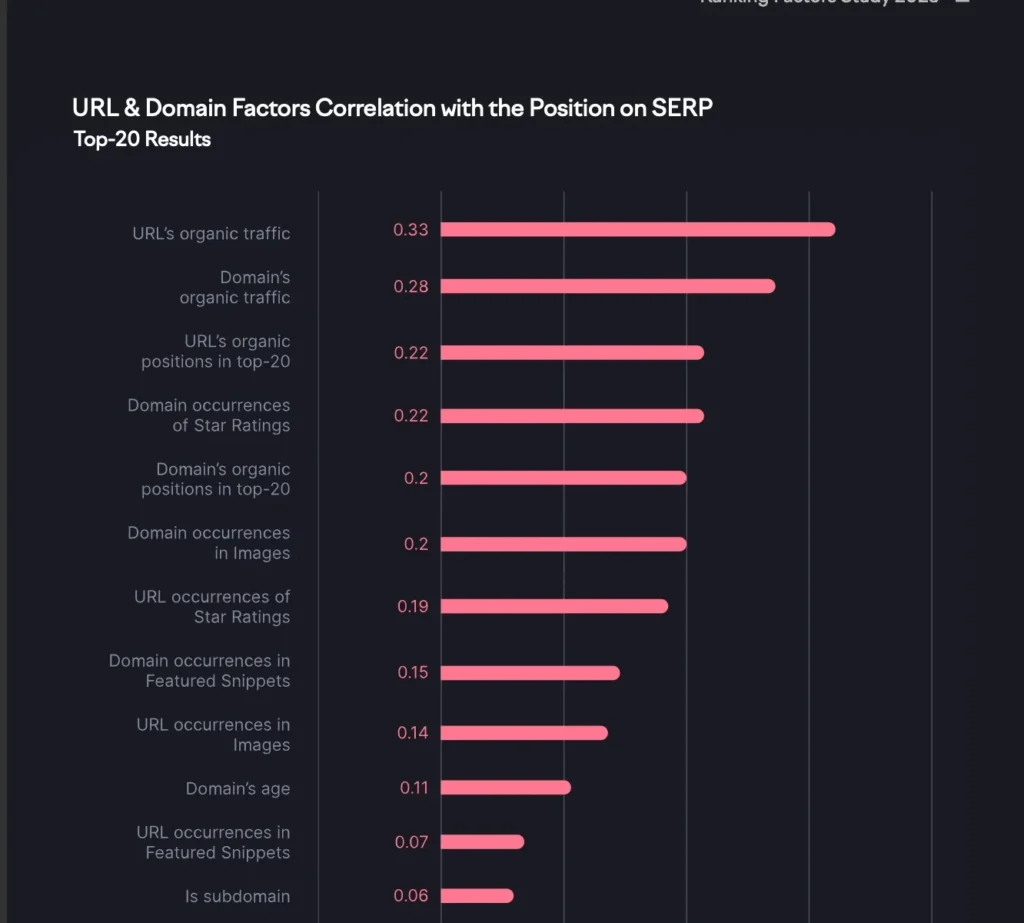
Any URL’s organic traffic, Domain’s organic traffic, and URL Listing in the top 20 correlate most to the SERP (Search Engine Results Page) factors.
This means higher organic traffic results in higher ranking, which would result in more increased traffic.
- Key Metrics:
- Domain Authority: A measure of the trustworthiness and quality of a domain, often influenced by backlink profiles.
- URL Structure: The clarity, brevity, and relevance of a webpage’s URL to its content.
- Domain Age: Older domains are considered more credible, although this is less significant than other factors.
- Keyword Usage in URL: Appropriately use the keywords in the URL for relevance; DO NOT over-optimize.
- Top Tips:
- Simplify URL Structure: Use clear, concise, and descriptive URLs that include relevant keywords and are easy to read.
- Consistent Domain Usage: Stick with a single, primary domain to build authority over time.
- Secure Your Domain: Use HTTPS to enhance security and trustworthiness.
- Optimize for Crawlability: Ensure that your site structure and URL hierarchy are logical and easily navigable by search engines.
- To Avoid:
- Avoid Overly Complex URLs: Long or confusing URLs can negatively impact user experience and crawlability.
- Avoid Keyword Stuffing: Overusing keywords in URLs can be seen as spammy and may hurt rankings.
- Avoid Frequent Domain Changes: Regularly changing your Domain can disrupt the building of domain authority.
- Don’t Neglect HTTPS: Unsecured websites (HTTP) are often penalized in rankings and can deter users.
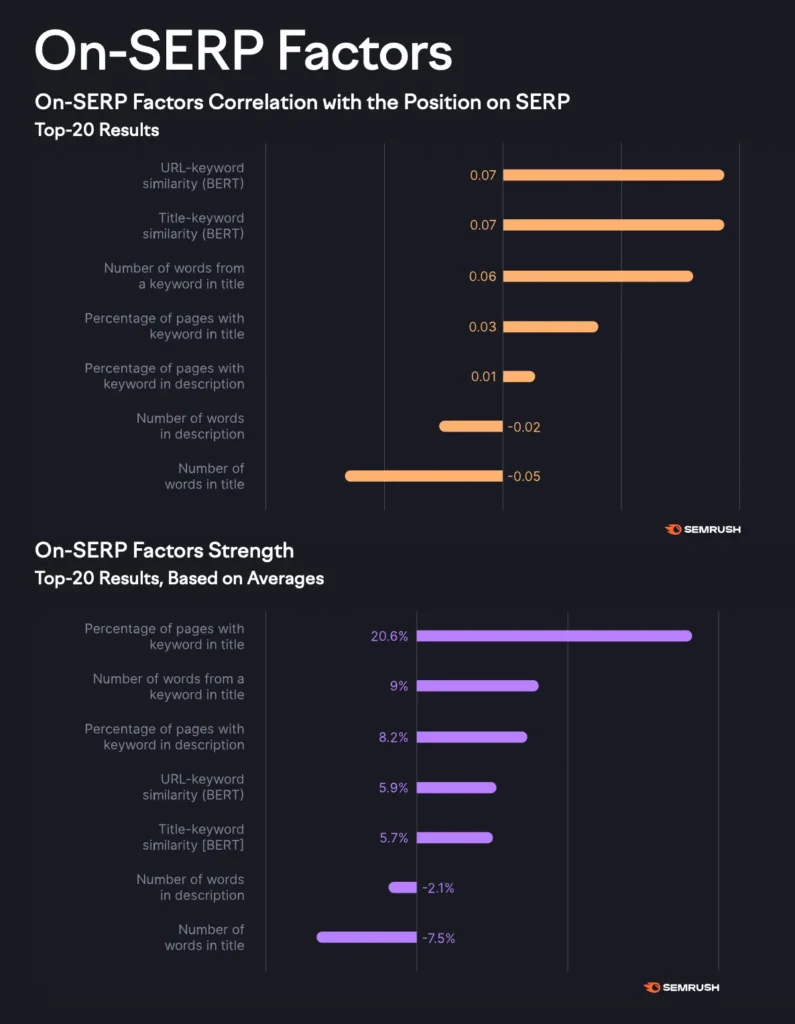
4. SERP Factors
To simplify, SERP (Search Engine Result Pages) are responses that Google shares when you query.
SERP determines how your site appears on Google – and that’s why they are so important.
Hence, knowing the best strategies for SERPs optimizes your content for ranking presentation and engagement on the SERPs.
- Key Metrics:
- Click-Through Rate (CTR): Improve your title and description to increase the number of clicks from SERP.
- Local Pack Listings: How often your site appears in local pack results for local businesses defines your ranking.
- Meta Title and Description Quality: Your meta titles and descriptions’ relevance and compelling nature.
- Top Tips:
- Optimize for Featured Snippets: Structure your content for featured snippets, and write clear and concise answers.
- Improve Local SEO: Ensure accurate and complete Google My Business profiles and use local keywords for local pack optimization.
- Craft Compelling Meta Titles and Descriptions: Write engaging and relevant meta titles and descriptions that encourage clicks.
- Utilize Schema Markup: Implement structured data to enhance the likelihood of your content appearing in rich results and other SERP features.
- To Avoid:
- Neglecting Meta Title and Description: Failing to optimize will lead to lower CTRs
- Overusing Keywords in Meta Tags: Stuffing keywords in titles and descriptions could be penalized.
- Ignoring Mobile Optimization: Not optimizing for mobile users can adversely affect your visibility and user experience on mobile devices.
- Overlooking Structured Data: Need to use schema markup.
5. User Experience and SEO Signals
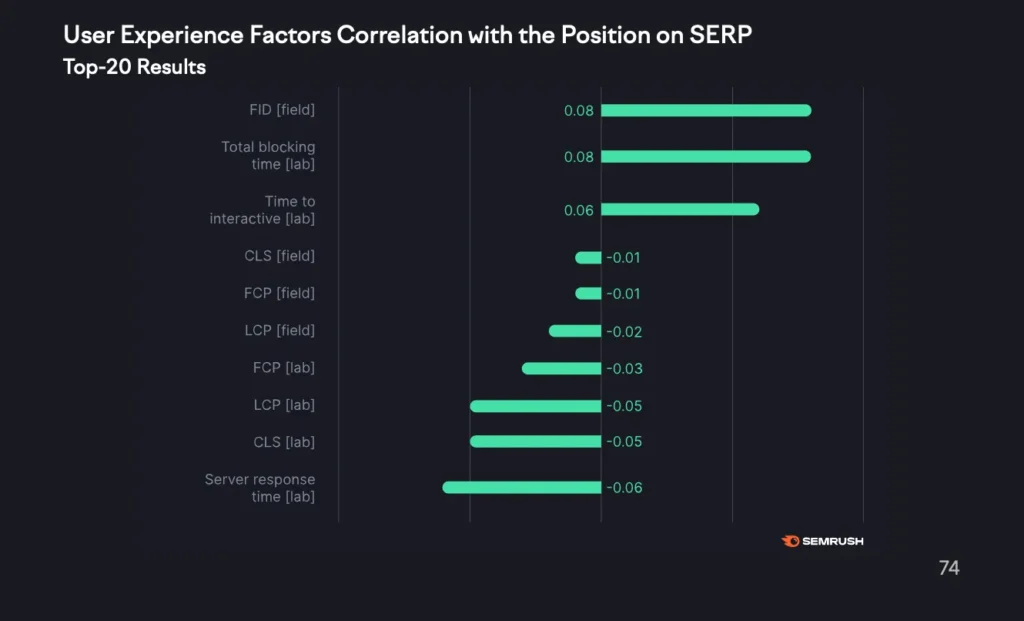
SEMRush also evaluates user experience signal on a website, correlating with SERP position. Signals like CLS (Cumulative Layout Shift), FCP (First Contentful Paint), FCP [field], FID (First Input Delay).
This is actually in alignment with Google’s statement –
“While not all of these may be directly used to inform ranking, we find that all of these aspects of page experience align with success in search ranking and are worth attention.” (ref)
As per the report, there was minimal to no correlation between these signals individually on the ranking factors.
But collectively, they can impact user experience on the website, impacting the retention or bounce-off rate.
Hence, actively monitoring these performances for a satisfactory user experience is suggested.
Conclusion
And there you have it, folks – a tour of the SEMRush Google Ranking Factors Report for 2024.
Let’s face it: SEO can sometimes feel like trying to solve a Rubik’s Cube blindfolded, but this report sheds some much-needed light on what Google’s looking for.
The days of keyword stuffing are outdated. Now, it’s all about enriching your content with value, building quality backlinks, and making your website on the internet that users and search engines love.
Remember, in the ever-changing landscape of SEO, staying informed and adaptable is your golden ticket.
Use these insights from the SEMRush report not just as a one-time fix but as a compass for your ongoing SEO journey.
Happy SEO-ing!