
Table of Contents
The marketing strategy for any business revolves around content – a lot of content, Top-of-the-funnel, Middle-of-the-funnel, Bottom-of-the-funnel, Sales enablement, customer success, and many more.
These are further broken down into categories and segments depending on the target audience, demography, number of products, etc.
Behind every successful product lies a tale of targeted content, touching hearts, and solving problems.
While most SaaS businesses focus a lot more on Top-of-the funnel content, which helps them build an audience and convert their visitors to leads, a definite strategy for converting Leads to customers is equally essential.
This is where Product Marketing Content enables businesses in 2 ways –
- Connecting product with marketing
- Enabling sales and success
In a content cycle, a product marketer focuses a lot on Bottom-of-the-funnel content, helping visitors understand the product, services, and features, accelerating the buying process, and helping make the decision faster.
The product marketing content (of various types) deep dive into nuances of the product from multiple facets that resonate with customer pain points and help them solve their problem effectively.
Since Product marketing as a function works closely with Sales. They also develop content that helps in sales enablement –
- Addressing prospect concerns and queries about the product
- Creating assets to train and enable sales and success teams to make them market-ready.
Here is a list of 18 types of Product marketing content for B2B businesses –
- Teaser campaigns
- Product Launch Blogs
- Product Introduction Video
- Product Webinar
- Case Studies and customer testimonials
- White papers
- Comparison Doc
- Tutorials and Demos
- Product Datasheets
- Third-Party Reviews
- User Manuals and Guides
- Tutorial Videos
- Digital Adoption Platform
- User-Generated Content (UGC)
- Referral Campaigns
- Community Forums
- Product Newsletter
- Drip Campaigns
Since most Product marketing content revolves around Bottom-of-the-funnel content and Sales Enablement.
To simplify things, we can divide the content based on the customer journey and product lifecycle.
- Awareness Stage: Introducing the Product
- Consideration Stage: Deep Dives and Details
- Decision Stage: Convincing the Prospect
- Post-Purchase: Onboarding and Retention
- Advocacy Stage: Turning Customers into Champions
- Continuous Engagement
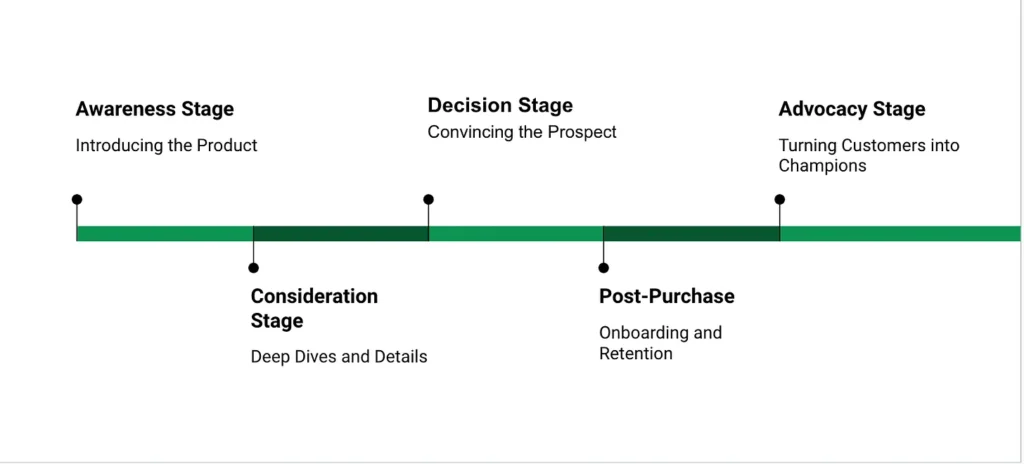
Product Marketing content based on Customer LifeCycle
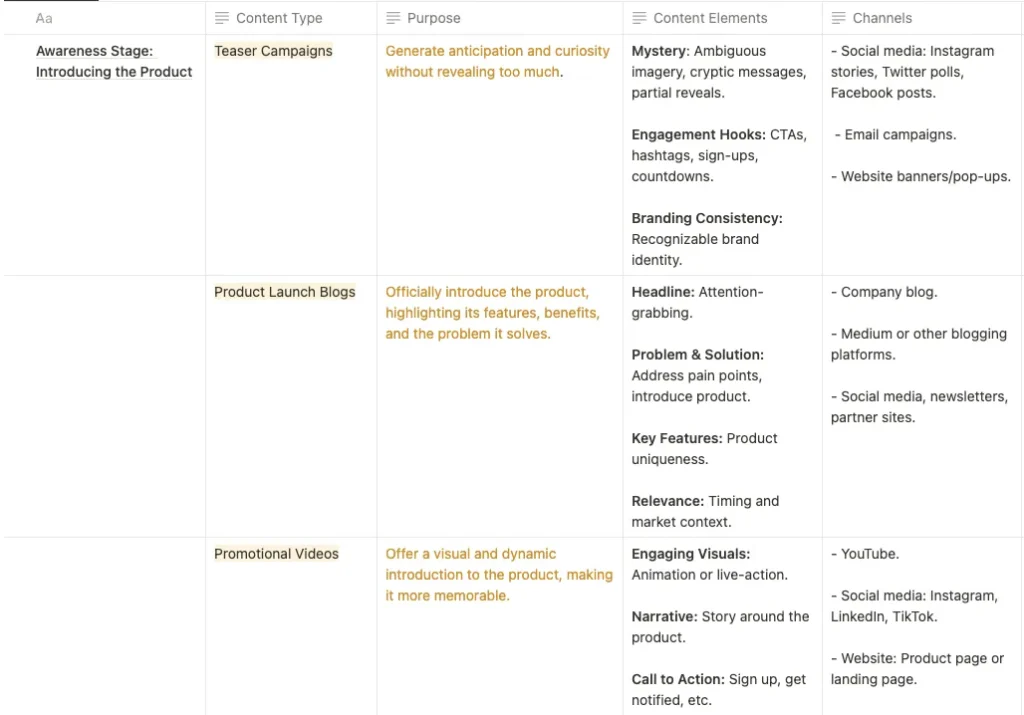
1. Awareness Stage – Introducing the Product
This stage is when the user, after his journey across TOFU, MOFU content is introduced to the product or services for the first time. This stage intends to capture attention, spark interest, and create awareness.
The primary objective is to make potential customers curious and eager to learn more. Here’s how content helps in this stage
- Teaser campaigns: These campaigns help to generate curiosity and anticipation around the product. The content created should have a mystery around it, making the user guess and talk about what’s coming.
You can use social media channels and email campaigns to reach your subscribers or create website banners to generate curiosity. Call-to-actions may include hashtags, joining the waitlist, sign-up for early access, etc.
Tip: Sticking to brand identity is essential so that the product is recognized as part of the more prominent family. - Product Launch Blogs: One of the favorites for B2B SaaS, Product launch blogs highlight product features, benefits, and the problem the product would solve.
The blog should have a capturing headline to gain immediate attention, address the pain point, and introduce the product as a solution. Highlight unique features and any other highlights.
Tip: Use a popular blogging platform for distribution - Product Introduction Video: Create a video explaining the product features, the pain points addressed, and the solution in a visually appealing way. Understand user persona to decide the video style; it could be animated or stock footage video, depending on the type of user segment.
Product videos are an excellent way to reach a YouTube vase audience and SEO benefits. You can also use the video on the product landing page.
Tip: TikTok videos have a great reach in the North American market
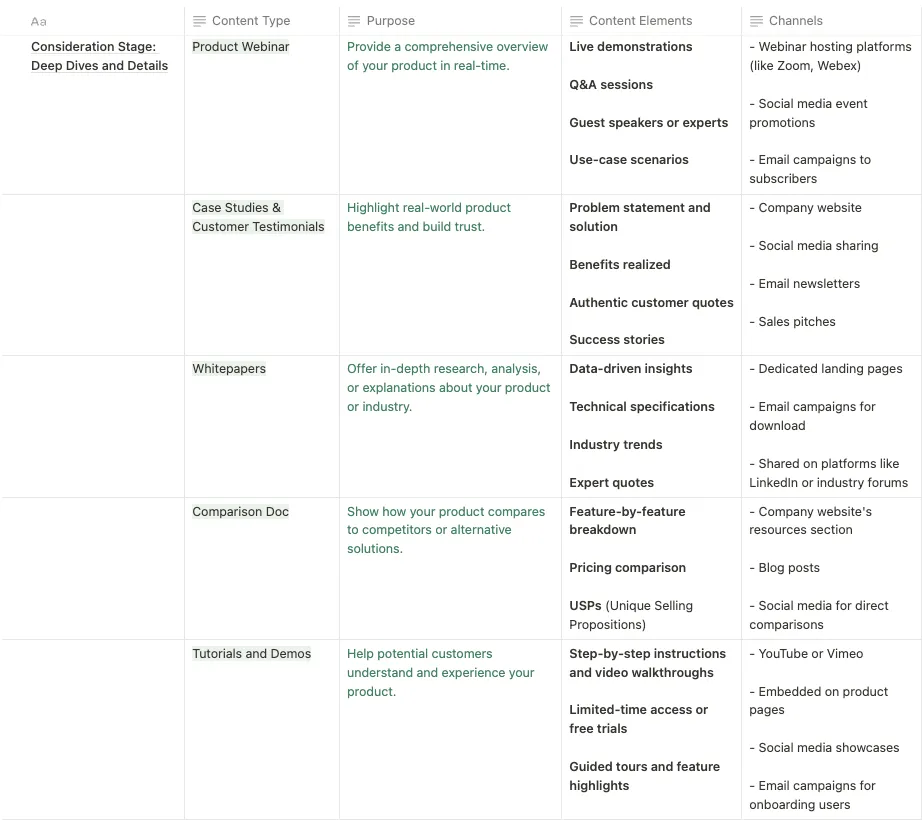
2. Consideration Stage: Deep Dives and Details
In the customer’s journey, the consideration stage is highly pivotal. This is where a customer is already aware of the product and is now evaluating if it fits their need and requirements.
They consider every product feature, weighing it against the alternatives and understanding deeper insights that help them make the decisions.
Here are all the content’s that fall under this stage
- Product Webinar: Product webinars provide a comprehensive real-time overview of the product, features, and functionalities. Most webinars capture product usage in live scenarios, with active Q&A sessions to engage with customers.
- Case Studies and customer testimonials: Case studies are the best way to showcase how your product has been helpful in the real world with examples. Start with a clear problem statement, followed by a solution provided, realized benefits, and a customer testimonial to make it authentic.
- White papers: Create in-depth analysis of new industry trends. Offer in-depth research explanations to trending topics that help establish your organization as a thought leader.
- Comparison Doc: Create a detailed comparison doc with various alternatives. Have detailed feature breakdowns, pricing comparisons, unique selling propositions, etc, that help differentiate your business and others.
- Tutorials and Demos: Product walkthroughs are one of the best ways to help customers understand product features and their usage for the solution. It also helps in clearly explaining the use of the product. Demos or Free trials give a clear first-hand experience, developing authority and reliability.
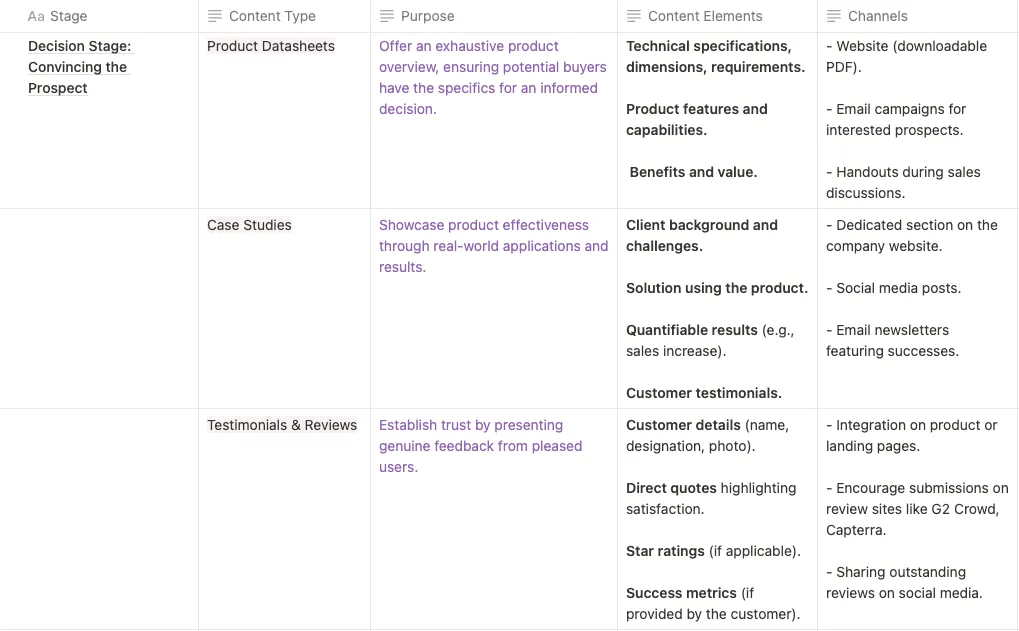
3. Decision Stage: Convincing the Prospect
This is a crucial stage for both the customer and the seller. The customer is on the verge of making the decision, and the objective is to instill trust in him about the product’s effectiveness and reliability.
This is done through testimonials, case studies, and exhaustive datasheets.
- Product Datasheets: Product datasheets are comprehensive insights into product characteristics and features. Good product datasheets are highly influential pieces of content in decision-making for customers.
It summarizes a product’s performance, technical aspects, components, materials, and use cases. Product sheets are often created as per customer requirements or are vertical-specific. - Case Studies: As in the previous section, Case studies highlight the real-world efficacy of your product, presenting successful applications and tangible results.
They begin by outlining the client’s initial challenges, then delve into how the product served as a solution, emphasizing measurable outcomes like sales boosts or time savings. - Third-Party Reviews: Third-party reviews have been a rage in recent years. Reviews help build credibility and trust when put forward through a genuine source. Websites like G2Crowd, Capterra, trust Pilot, etc, are popular places to collate user reviews.
4. Post-Purchase: Onboarding and Retention
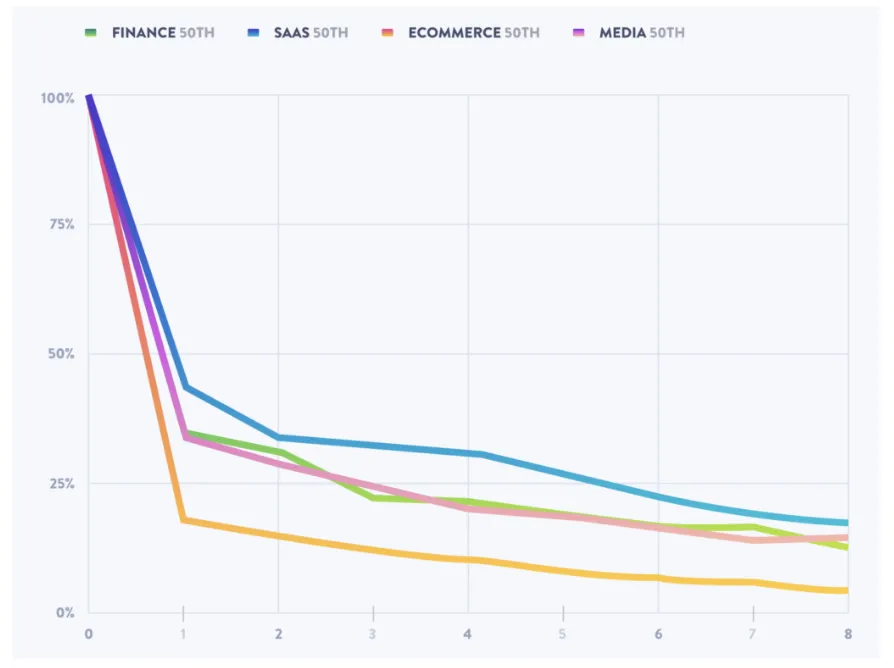
For most industries, the average eight-week retention is below 20 percent. Considering the average cost of acquisition of a mid-market SaaS user is about $1500 – $6000, post-purchase engagement and retention remain a central mystery to solve for most SaaS businesses.
Content in this phase aims to guide users through the early stages of the product. A properly executed Onboarding process can lead to long-term satisfied customers and improve retention. Here are different types of content for this stage
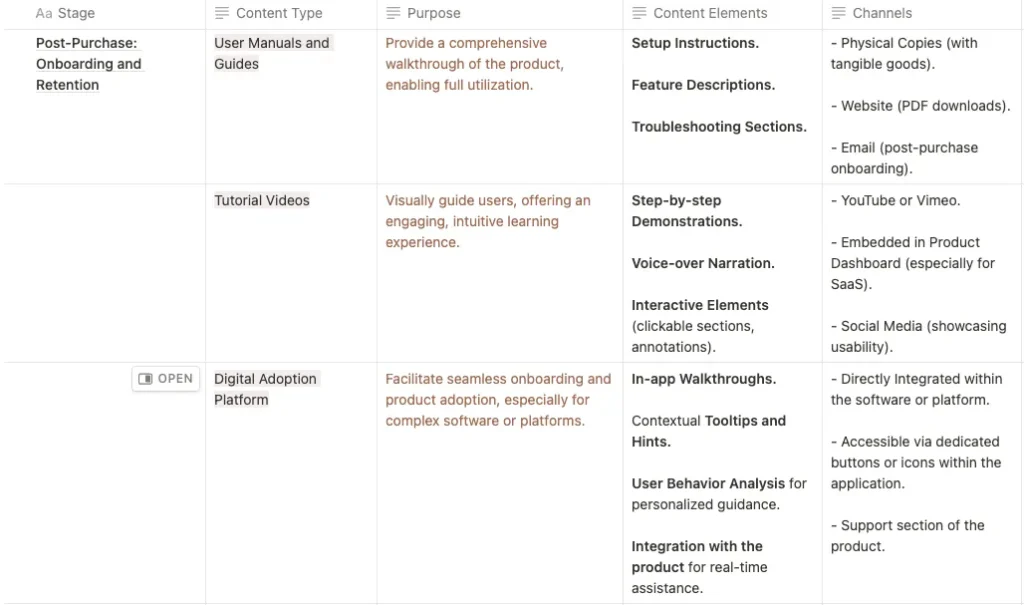
- User Manuals and Guides: The most crucial content at this stage is a thorough, structured walkthrough that helps users understand the product. Getting started, features list, and frequently asked questions are some of the pointers to be covered in the manual.
Downloadable versions should be easily accessible on the website and in-product and must be shared via email on onboarding. - Tutorial Videos: Video consumption is at an all-time high. Create step-by-step demos and highlight interactive elements to create a user-friendly video. Keep track of video consumption to see how your videos are being used.
- Digital Adoption Platform: Digital Adoption Platforms (DAP) are no-code products that integrate over any application, software, or development and provide contextual information to the user as they navigate. DAP is intently focused and helps improve product usage, eventually increasing retention.
5. Advocacy Stage: Turning Customers into Champions
Customers are not just product users but actively endorse and promote it. This stage is crucial as it leverages word of mouth, arguably the most trusted form of marketing.
Let’s take a look at the type of content for this stage.
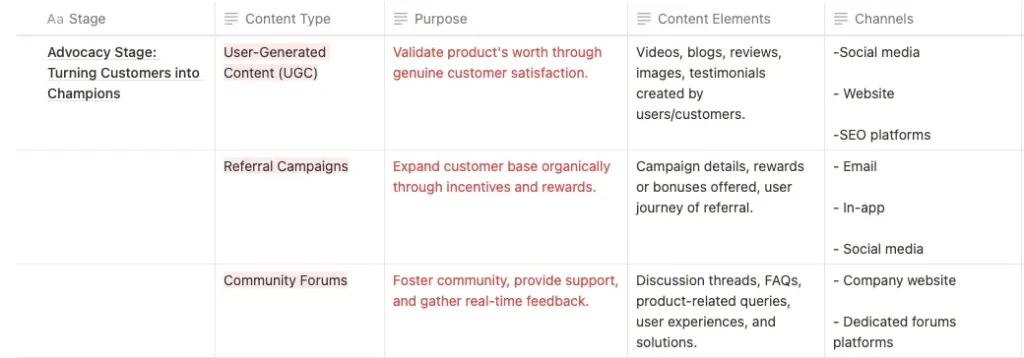
- User-Generated Content (UGC): User-generated content refers to any content—videos, blogs, reviews, images, or testimonials—created by users or customers rather than the brand itself. UGC can help significantly reduce content generation costs while enhancing authenticity. UGC is also a great way to generate SEO juice with its fresh take and approach.
- Referral Campaigns: Referral campaigns incentivize your current customer base to introduce your product to others. Businesses can organically expand their customer base by offering rewards or bonuses for each successful referral. At its core, a referral is a vote of confidence from one customer to another potential customer.
- Community Forums: Community forums are platforms where users can share their experiences, ask questions, and offer solutions related to the product. It’s a collaborative space where company representatives and product users interact. These forums nurture a sense of community, belonging, and support among users. They can also serve as feedback channels for product improvements.
6.Continuous Engagement
Continuous engagement is vital to maintaining and growing customer relationships, ensuring they remain informed and valued.
It is necessary to keep the customers updated on new releases and product updates that constantly add value to their business. This also helps in reducing churn and increases chances of Upsell & Cross-Sell.
<Read this excellent article – A complete guide to retention and churn rates for B2B SaaS>
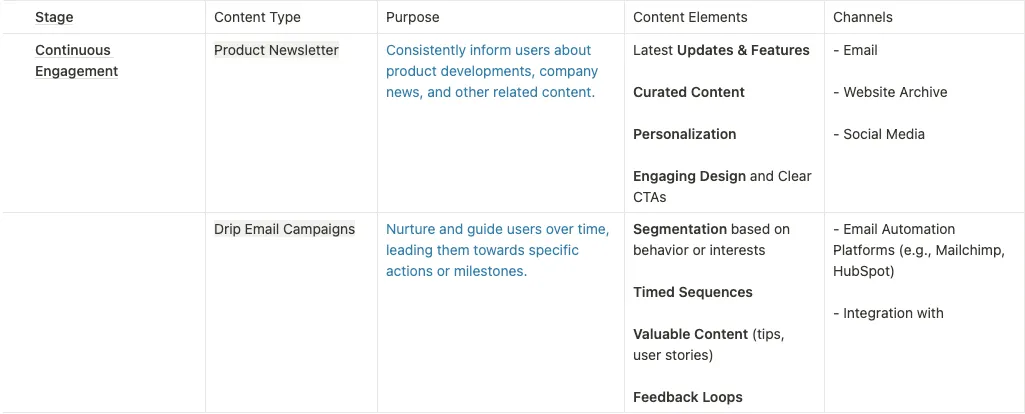
- Product Newsletter: Create a monthly newsletter updating users on the latest product and feature releases to keep customers updated on new improvements.
Highlight key advantages or value of these updates, accompanied by video gifs to make them interactive and easy to understand. Cross-post this newsletter as a blog to increase the outreach and ripe SEO benefits.
Tip: Use data or behavior to tailor content, ensuring it’s most relevant to their interest. - Drip Campaigns: Create Targeted emails based on user behavior, purchase history, or engagement levels. This nurtures and guides users, leading them from customers to product champions.
Drop in tips, tricks, user stories, etc., to demonstrate potential. Integrate email with CRM for tracking and refining targeting.
In Conclusion
The journey of content in product marketing is intricate, dynamic, and transformative. As we traverse from the initial touchpoints of awareness to the enduring relationship of advocacy, it’s evident that content is not just about words or videos.
It’s about connecting, resonating, and constantly engaging with our audience. It’s a continuous dialogue that requires intuition, strategy, and, most importantly, understanding the ever-evolving needs of our customers.
While the stages we discussed provide a framework, the real magic lies in the nuances—the personalized touch in an email, the authenticity of a testimonial, or the clarity of a tutorial. As SaaS businesses, our challenge is producing content and crafting experiences that lead, guide, and walk alongside our customers at every step of their journey.
In this digital age, where choices are ample and attention spans are short, let’s pledge to make every word, video, and campaign count.
Because, in the end, it’s all about forging lasting relationships, one content piece at a time.